Sewri Fort and Flamingo Mudflats

About

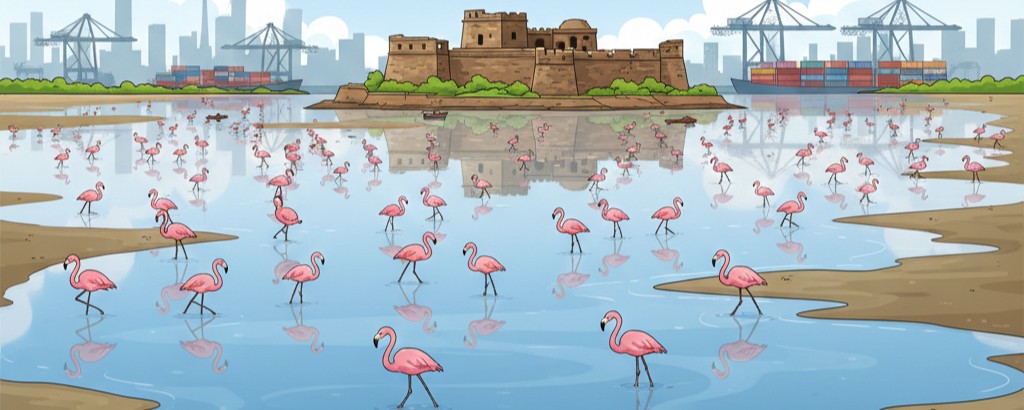
Long Description — Sewri Fort & Flamingo Mudflats, Mumbai 🏰🦩🌿 Sewri Fort & Flamingo Mudflats in Mumbai are a compact yet compelling pairing of history and ecology. The fort, constructed as a coastal watchtower in 1680, perches on basalt outcrops overlooking the eastern waterfront. Below it, the Sewri mudflats and adjacent mangrove fringes across Thane Creek form vital feeding grounds for migratory shorebirds — most famously the thousands of lesser flamingos that visit during the winter months.

The contrast is striking: crumbling fort walls and bastions above, and expansive, shimmering mudflats below where birds wheel and feed at low tide. The area is mainly popular with birdwatchers, photographers, and locals seeking a quiet sunrise rather than large-scale tourism. Facilities are minimal — expect basic paths, uneven terrain, and limited seating — but the natural spectacle, especially at dawn, rewards early arrival.

Key facts and highlights:

  • Built as a British East India Company watchtower in 1680.
  • Visible remains include basalt defensive walls, a stone gateway, and ruined internal rooms.
  • Sewri mudflats form part of the Important Bird & Biodiversity Area (IBA) for Thane Creek.
  • Flamingo season primarily runs October–March, peaking in January–February.
  • Best viewing is at sunrise when birds are most active and light is ideal for photography.
  • Accessibility: nearest rail access is Sewri Railway Station (Harbour Line); short auto/foot approaches from the station or Sewri Jetty.
  • Conservation note: ongoing pressures from urban development and port activities; restoration and viewing-gallery projects have been proposed.
  • Visitor experience: mostly open-air, low amenities — carry water, binoculars, and sun/rain protection.
  • Photography tip: use a telephoto lens (200mm+) or binoculars; low tide produces better bird concentrations.

Why visit:

  • Unique combination of a coastal heritage fort and a globally significant birding wetland in the heart of Mumbai.
  • Exceptional sunrise scenes and reflective water photographs when flamingos gather.
  • Educational value for urban ecology and conservation conversations.
History

History of Sewri Fort & Flamingo Mudflats 🏰🦩 The history of Sewri Fort & Flamingo Mudflats in Mumbai is a fascinating combination of British military strategy and the natural evolution of Thane Creek's wetland ecosystem.

The fort was built by the British East India Company in 1680 as a watchtower to guard the eastern waters of Bombay and protect trade routes. Over the centuries, it witnessed battles, invasions, and changing coastal dynamics — while the mudflats below slowly transformed into a globally significant bird habitat.

Key Historical Highlights

  • Built in 1680 as a defensive watchtower overlooking Bombay harbour.
  • Constructed by the British East India Company to spot naval threats.
  • In 1689, captured briefly by Siddi general Yadi Sakat during a major attack on Bombay.
  • Repelled a Portuguese naval attempt in 1772.
  • Later used as a warehouse/godown under port authorities once military importance declined.
  • Surrounded by marshy coastline that gradually expanded due to sedimentation and tidal flow changes.
  • Flamingos began arriving in significant numbers from the 1990s onwards, shifting the area’s identity from military outpost to wildlife hotspot.
  • Today, the fort stands partly in ruins, while the mudflats below are part of an Important Bird & Biodiversity Area (IBA).

Why This History Matters

  • Shows the maritime heritage of Mumbai's eastern coastline.
  • Demonstrates how natural ecosystems can revive around old urban structures.
  • Highlights the shift from colonial defense to ecological conservation.


Architecture & Design

Architecture & Design of Sewri Fort 🧱🏰 The architectural style of Sewri Fort in Mumbai reflects the functional, military-focused construction typical of the British East India Company during the late 17th century.

Built primarily for surveillance and coastal defense, the fort is compact, robust, and situated strategically on a rocky hill overlooking Thane Creek. While much of it now lies in ruins, its structural elements still showcase the engineering approach used for small coastal forts of the period.

Key Architectural Features

  • Constructed using basalt stone and lime mortar, ensuring durability against coastal weather.
  • Features thick defensive walls built to withstand cannon fire.
  • A small stone gateway marks the fort’s entrance.
  • Originally had bastions positioned for cannons facing the harbour.
  • Remnants of vaulted chambers and internal rooms are still visible.
  • Elevated position offers a 360-degree vantage over Thane Creek.
  • Minimal ornamental work, focused entirely on military function.

Visual & Structural Character

  • Weathered basalt exterior with darkened stone surfaces.
  • Inner areas resemble a hollow courtyard where rooms once stood.
  • Open terraces now serve as informal viewing decks for flamingos and mudflats.
  • Strong contrast between rugged fort walls and the calm wetlands below.

Importance of the Design

  • Represents early British military architecture in western India.
  • Shows how forts prioritised visibility and defense over ornamentation.
  • Highlights the use of local basalt for quick, sturdy construction.
0215
Ecology & Mudflat Formation

Ecology & Mudflat Formation of Sewri Flamingo Mudflats 🌿🦩🌊

The Sewri Mudflats in Mumbai are part of the wider Thane Creek wetland system, one of India’s most ecologically sensitive coastal zones. These mudflats formed over decades due to tidal action, sediment deposition, and the natural build-up of silt from streams and drainage channels. The nutrient-rich environment supports algae, molluscs, crustaceans, and microorganisms that attract thousands of migratory birds, especially lesser flamingos.

How the Mudflats Formed

  • Created through continuous sediment deposition shaped by tidal flow.
  • Urban development altered water channels, increasing silt accumulation.
  • Mangroves trap sediments, helping stabilise the mudflat areas.
  • Low-lying terrain creates shallow pools perfect for wading birds.
  • Area expanded significantly since the 1990s.

Ecological Importance

  • Part of an Important Bird & Biodiversity Area (IBA).
  • Supports lesser flamingos, herons, egrets, sandpipers, and migratory species.
  • Strong mangrove ecosystem provides coastal protection.
  • Feeding and breeding grounds for marine micro-life.
  • Natural buffer against tidal surges and shoreline erosion.

Why Flamingos Love This Habitat

  • Rich in blue-green algae, the flamingos’ primary food source.
  • Shallow waters ideal for filter-feeding.
  • Lower human disturbance than other urban shores.
  • Suitable climate during October–March.
  • Open mudflats provide safe space for large flocks.

Environmental Challenges

  • Threats from coastal construction and infrastructure activity.
  • Imbalanced sedimentation from altered drainage patterns.
  • Potential disturbance from nearby industrial zones.
  • Mangrove degradation in surrounding belts.


Flamingo Migration & Wildlife

Flamingo Migration & Wildlife at Sewri Mudflats 🦩🌍🌿

The Sewri Flamingo Mudflats in Mumbai are one of the most important wintering grounds for lesser flamingos in India. Every year, thousands of these pale pink birds arrive from the Rann of Kutch and western regions, turning the mudflats into a vibrant winter spectacle.

The area attracts more than 12–15% of South Asia’s lesser flamingo population and is a favourite among birdwatchers and photographers.

Flamingo Migration Highlights

  • Flamingos migrate mainly from the Rann of Kutch.
  • Peak viewing season: October to March, especially January–February.
  • Flocks feed on naturally occurring blue-green algae.
  • Filter-feeding beaks help them extract algae from shallow waters.
  • Best sightings occur during low tide.

Other Birds & Wildlife

  • Common species: herons, egrets, sandpipers, curlews, stilts, gulls.
  • Occasional raptors circle above the wetlands.
  • Mudflats support crustaceans and molluscs.
  • Mangroves harbour insects, fish, and microorganisms.

Why Sewri Is Special for Flamingos

  • High algae density ideal for mass feeding.
  • Wide, open mudflats provide safe landing zones.
  • Lower human disturbance than other waterfronts.
  • Favourable climate during winter.
  • Excellent visibility for photography.

Wildlife Photography Tips

  • Visit at sunrise for golden lighting.
  • Bring a 200mm–400mm telephoto lens.
  • Best activity during low tide.
  • Use a tripod for stability over long distances.
  • Avoid loud noises or abrupt movement.
0415
Viewpoints & Photography Spots

Best Viewpoints & Photography Spots at
Sewri Fort & Flamingo Mudflats
📸🌅🦩

Sewri Fort & Flamingo Mudflats in Mumbai offer a variety of vantage points for birdwatchers and photographers. Elevated fort areas, jetty edges, and mangrove zones provide excellent views of flamingos, wetlands, and sunrise colours.

Top Viewpoints

  • Sewri Fort Upper Terrace – Elevated basalt platform ideal for panoramic views.
  • Sewri Jetty – Closest point to flamingo gatherings; perfect for telephoto shots.
  • Mangrove edge zones with shallow feeding areas.
  • Creekside walk path for sunrise silhouettes.
  • Fort entrance ramp offering fort wall views with mudflats in the backdrop.

Best Photography Spots

  • Eastern-facing points for sunrise light.
  • Jetty edges during low tide.
  • Fort corners overlooking Thane Creek.
  • Mangrove belts for close shots of waders.
  • Jetty rails for tripod-based long exposures.

Photography Tips

  • Use a 200mm–400mm telephoto lens for close flamingo shots.
  • Carry a wide-angle lens for landscape frames.
  • Tripod recommended for stability.
  • Avoid disturbing feeding birds by staying at a distance.
  • Low tide gives better view of flocks.
  • Sunrise offers warm colours and calm atmosphere.


Best Time to Visit

Best Time to Visit Sewri Fort & Flamingo Mudflats ⏰🦩🌤️

The best time to visit Sewri Fort & Flamingo Mudflats in Mumbai aligns with the winter migration of flamingos and favourable light for photography.

Seasonal Breakdown

  • October to March – peak flamingo migration; best sightings.
  • January to February – maximum flock sizes and feeding activity.
  • Early mornings (sunrise) – soft golden light and active birds.
  • Low tide – ideal for group feeding visuals.
  • Avoid monsoon season due to high water levels and no flamingos.

One-Line Reason:

  • October–March is ideal because this is the peak flamingo migration season with high sighting chances.


Visitor Experience

Visitor Experience at Sewri Fort & Flamingo Mudflats 👣🦩🌅

The visitor experience at Sewri Fort & Flamingo Mudflats in Mumbai is peaceful, scenic, and strongly connected to nature. Many visitors arrive early in the morning for flamingo sightings, while others explore the quiet ruins of Sewri Fort and enjoy panoramic views of Thane Creek.

What Visitors Usually Experience

  • A calm, serene escape from busy city areas.
  • Beautiful sunrise views over the mudflats.
  • Sightings of lesser flamingos during winter.
  • Easy access to Sewri Jetty for closer views.
  • Rugged pathways and old fort walls.
  • Open-air, breezy viewing points.
  • Great opportunities for photography.

What to Expect at the Fort

  • Weathered basalt walls and ruins.
  • Basic walkways with minimal facilities.
  • Informal viewing areas overlooking the creek.
  • Limited shade or resting spots.

What to Expect at the Mudflats

  • Wide shallow pools during low tide.
  • Flamingo feeding activity in groups.
  • Muddy terrain requiring firm footwear.
  • Other migratory birds in the area.

Good for These Types of Visitors

  • Birdwatchers
  • Nature photographers
  • Researchers and students
  • Early-morning travellers
  • People who prefer quiet, offbeat spots
0715
Facts & Figures

Facts & Figures — Sewri Fort & Flamingo Mudflats 📊🦩🏰

This section provides quick-reference details about Sewri Fort & Flamingo Mudflats in Mumbai.

Fort-Related Facts

  • Built in 1680 by the British East India Company.
  • Type: Coastal watchtower fort.
  • Materials: Basalt stone and lime mortar.
  • Main feature: One primary bastion facing the harbour.
  • Condition: Ruins with partial walls standing.
  • Elevation: About 20–25 metres above the creek.

Mudflat & Wildlife Facts

  • Habitat: Intertidal wetland and mangrove ecozone.
  • Flamingo species: Lesser Flamingo (Phoeniconaias minor).
  • Population share: 12–15% of South Asia’s winter flamingo population.
  • Migration season: October–March.
  • Best viewing: January–February.
  • Status: Part of the Thane Creek IBA.

Location & Access Facts

  • Nearest station: Sewri Railway Station (Harbour Line).
  • Walk to jetty: Around 10–12 minutes.
  • Entry fee: Free.
  • Best timing: Sunrise to late morning.
  • Facilities: Minimal; no food stalls or restrooms.

Unique Highlights

  • One of Mumbai’s best urban birdwatching sites.
  • Historic fort combined with an active wildlife habitat.
  • Panoramic views from the fort terrace.
  • Quiet, offbeat experience with low crowds.


Current Scenario & Conservation

Current Scenario & Conservation at Sewri Fort & Flamingo Mudflats 🌍🛡️🦩

The current situation at Sewri Fort & Flamingo Mudflats in Mumbai reflects a balance of ecological importance and human pressure. The mudflats remain a vital wintering site for lesser flamingos, while the fort stands in a weathered but accessible state.

Current Scenario

  • Annual arrival of flamingos during winter seasons.
  • Status as an Important Bird & Biodiversity Area (IBA) continues.
  • Sewri Fort remains partially ruined but open to visitors.
  • Basic pathways allow access despite uneven terrain.
  • Increased awareness among local communities.
  • Occasional guided nature walks.

Conservation Efforts

  • Plan for a flamingo viewing gallery at Sewri Jetty.
  • Proposed restoration work for Sewri Fort.
  • Bird population monitoring by wildlife groups.
  • Mangrove conservation initiatives along Thane Creek.
  • Awareness drives promoting responsible behaviour.

Key Challenges

  • Threats from major infrastructure and industrial activity.
  • Sedimentation changes from altered water flow.
  • Littering and visitor disturbance.
  • Degradation of nearby mangrove belts.
  • Reduced mudflat visibility outside winter.

Why Conservation Matters

  • Protects a unique urban wetland.
  • Supports thousands of migrating flamingos.
  • Strengthens coastal resilience.
  • Preserves the heritage value of Sewri Fort.
0915
Tips & Hacks

Tips & Hacks for Visiting Sewri Fort & Flamingo Mudflats 💡🦩📸

These tips help make your visit to Sewri Fort & Flamingo Mudflats in Mumbai smooth and enjoyable.

Essential Tips

  • Visit at sunrise for the best lighting and flamingo movement.
  • Check low-tide timings for better views.
  • Wear footwear with good grip due to muddy patches.
  • Carry binoculars or a zoom lens.
  • Bring water, snacks, and sun protection.
  • Keep belongings minimal due to uneven paths.
  • Avoid stepping near mudflat edges.

Photography Hacks

  • Use a 200mm–400mm lens for close flamingo shots.
  • Tripod recommended for long zooms.
  • Shoot during golden hour for warm tones.
  • Use fast shutter speeds for flying flocks.
  • Wide-angle shots work well from the fort terrace.

Safety & Environmental Care

  • Maintain a safe distance from flamingos.
  • Avoid loud noises and sudden movement.
  • Do not litter; carry back all waste.
  • Avoid damaging mangroves.
  • Follow instructions during guided walks.

Local Hacks

  • Auto rickshaws from Sewri Station are readily available.
  • Jetty approach roads can be narrow.
  • Carry a light jacket for breezy mornings.
  • Arrive early for better viewing points.


Safety Guidelines

Safety Guidelines for Sewri Fort & Flamingo Mudflats ⚠️🦩🚶

Because Sewri Fort & Flamingo Mudflats in Mumbai are natural and heritage environments, basic safety measures ensure a responsible visit.

General Safety

  • Watch for uneven stones and rugged fort pathways.
  • Avoid slippery edges near mudflat zones.
  • Stay on firm ground; mudflat surfaces can be unstable.
  • Supervise children near open water.
  • Carry a light jacket during winter mornings.

Wildlife & Environmental Safety

  • Maintain a safe distance from all birds.
  • Avoid loud sounds or sudden movement.
  • Do not enter mangrove patches.
  • Never feed wildlife.
  • Use binoculars for close viewing.

Health & Personal Safety

  • Carry water; there are no facilities.
  • Wear sunscreen, sunglasses, and a cap.
  • Avoid monsoon visits due to slippery ground.
  • Stay in open, visible areas if travelling alone.
  • Keep your phone charged for safety.

Weather-Related Caution

  • Sunrise is ideal; avoid midday heat.
  • Check tide timings in advance.
  • Avoid stormy or high-wind periods.


Additional Notes

Additional Notes for Sewri Fort & Flamingo Mudflats 📝🦩🏰

These notes provide extra context for planning a smooth visit to Sewri Fort & Flamingo Mudflats in Mumbai.

Useful Observations

  • Flamingo visibility varies with tide levels and algae presence.
  • Sightings often improve 2–3 days after a full moon.
  • The fort area is peaceful with minimal commercial activity.
  • Mudflats may seem quiet in non-winter months but remain active ecosystems.
  • Popular with nature clubs, students, and photographers.
  • No binocular rental services available.

Things to Keep in Mind

  • Paths may be slippery after rain or high tide.
  • Mobile network may weaken near the jetty.
  • Narrow lanes approaching the jetty require cautious navigation.
  • No restrooms on-site.
  • Carry extra water during summer visits.

Insights from Locals & Regular Visitors

  • Flamingos may shift positions; patience helps.
  • Arriving before sunrise ensures quieter surroundings.
  • Silence improves birdwatching quality.
  • Unique contrast between the fort’s rugged structure and flamingo flocks below.
01215
Fun Facts

Fun Facts about Sewri Fort & Flamingo Mudflats 🤩🦩🏰

Fun & Interesting Trivia

  • Sewri Mudflats host one of India’s largest winter flamingo gatherings.
  • Lesser flamingos get their pink colour from algae found in the mudflats.
  • About 12–15% of South Asia’s flamingo population arrives each year.
  • Sewri Fort once repelled a Portuguese attack in 1772.
  • Flamingos form unique flock shapes such as waves and ribbons.
  • Sunrise turns the mudflats into gold-pink hues perfect for photography.
  • The fort still offers panoramic views of Thane Creek.
  • Mudflats act like a buffet of blue-green algae for flamingos.
  • Feeding flamingos often display rhythmic head-bobbing movements.
  • Rare combination of a heritage fort with an active wildlife habitat.


How to Reach 🚌

How to Reach Sewri Fort & Flamingo Mudflats 🚌🚇

By Train

  • Nearest station: Sewri Railway Station (Harbour Line).
  • Travel time: CST 15–18 min, Wadala 5 min, Kurla 20 min.
  • Walk or take an auto (10–12 min) from the station.
  • Fare range: ₹10–₹20.

By Road / Auto / Taxi

  • Accessible from Sewri East via Eastern Freeway or P D’Mello Road.
  • Auto fare from station: ₹20–₹30.
  • Taxi fare from South Mumbai: ₹150–₹250.
  • Nearby landmarks: Sewri Jetty, Sewri Station, Sewri Church.
  • Jetty roads are narrow; expect slow movement.

By Bus

  • Nearest stop: Sewri Station (East).
  • Walk 10–15 min to reach the jetty.
  • Useful for budget travellers.

On Foot

  • Walk from Sewri Station towards the jetty road.
  • Terrain may be uneven with industrial surroundings.
  • Early mornings are safest for walking.

Ferry

  • No ferry services are available.

Local Tips

  • Arrive before sunrise for best views.
  • Avoid monsoon months for safety.
  • Ask taxis to drop you at Sewri Jetty directly.


Food Courts / Food Options Nearby

Food Options Near Sewri Fort & Flamingo Mudflats 🍽️🫓☕

Since Sewri Fort & Flamingo Mudflats in Mumbai are located in an industrial belt, there are no food outlets on-site. Nearby neighbourhoods offer several choices.

Quick Snacks & Tea Stalls (₹20–₹80)

  • Tea stalls near Sewri Station (East).
  • Snacks such as vada pav, samosas, bhurji pav.

Nearby Eateries (₹100–₹250)

  • Local Udupi-style restaurants in Sewri and Wadala.
  • Vegetarian breakfast items like idli, dosa, poha, upma.

Mid-Range Options (₹250–₹500)

  • Restaurants in Wadala, Parel, and Byculla.
  • North Indian meals, Chinese dishes, biryani, thalis.

Popular Options in Neighbouring Areas (₹300–₹700)

  • Cafés and casual dining in Parel and Lower Parel.
  • Sandwiches, salads, pasta, coffee, bakery foods.

What to Expect

  • No food stalls at the fort or mudflats.
  • Carry drinking water.
  • Snacks useful during early sunrise visits.
  • Nearest full-meal options available in surrounding areas.
0


Places Nearby Sewri Fort and Flamingo Mudflats
Frequently Asked Questions
Q1: What is the best season to visit Sewri Fort & Flamingo Mudflats in Mumbai?
A1: The best season to visit Sewri Fort & Flamingo Mudflats in Mumbai is between October and March when thousands of lesser flamingos migrate to the mudflats.
Q2: How early should I reach Sewri Fort & Flamingo Mudflats for flamingo viewing?
A2: It is best to reach Sewri Fort & Flamingo Mudflats around sunrise because the birds are most active in the early morning light.
Q3: Is there any entry fee for Sewri Fort & Flamingo Mudflats in Mumbai?
A3: There is no entry fee to visit Sewri Fort & Flamingo Mudflats in Mumbai, and both the fort and mudflats are freely accessible to the public.
Q4: How far is Sewri Fort & Flamingo Mudflats from Sewri Railway Station?
A4: Sewri Fort & Flamingo Mudflats are about a 10 to 12 minute walk or a short auto ride from Sewri Railway Station.
Q5: Are flamingos visible throughout the day at Sewri Fort & Flamingo Mudflats?
A5: Flamingos at Sewri Fort & Flamingo Mudflats are usually most visible during low tide and early morning, while visibility decreases as the day gets hotter.
Q6: Is Sewri Fort & Flamingo Mudflats safe for solo travellers?
A6: Yes, Sewri Fort & Flamingo Mudflats are generally safe for solo travellers during morning hours, but visitors should stay in open areas and avoid isolated corners of the fort.
Q7: Do I need special equipment to photograph flamingos at Sewri Fort & Flamingo Mudflats?
A7: A telephoto lens between 200mm and 400mm helps capture clear images at Sewri Fort & Flamingo Mudflats, though binoculars are useful for casual viewing.
Q8: Can I visit Sewri Fort & Flamingo Mudflats during monsoon?
A8: Visiting Sewri Fort & Flamingo Mudflats during monsoon is not recommended because the mudflats get submerged and the pathways become slippery.
Q9: Are there restrooms or food stalls near Sewri Fort & Flamingo Mudflats?
A9: There are no restrooms or food stalls at Sewri Fort & Flamingo Mudflats, so visitors should carry water and snacks and plan accordingly.
Q10: Is parking available near Sewri Fort & Flamingo Mudflats in Mumbai?
A10: Limited roadside parking is available near the approach to Sewri Fort & Flamingo Mudflats, but the lanes are narrow and visitors should arrive early.
Q11: Why do flamingos visit Sewri Fort & Flamingo Mudflats every year?
A11: Flamingos visit Sewri Fort & Flamingo Mudflats because the mudflats contain blue-green algae, shallow waters, and calm feeding zones ideal for their winter habitat.
Q12: How long does a typical visit to Sewri Fort & Flamingo Mudflats take?
A12: A visit to Sewri Fort & Flamingo Mudflats usually takes one to two hours, including time for birdwatching and exploring the fort's ruins.
Q13: Is Sewri Fort & Flamingo Mudflats suitable for children?
A13: Children can visit Sewri Fort & Flamingo Mudflats, but adults should supervise them closely due to uneven surfaces and open mudflat edges.
Q14: Can I access the mudflats directly at Sewri Fort & Flamingo Mudflats?
A14: Direct access to the mudflats at Sewri Fort & Flamingo Mudflats is not recommended because the ground can be soft, slippery, and unsafe for walking.
Q15: Are guided tours available at Sewri Fort & Flamingo Mudflats?
A15: Occasional guided walks and birdwatching sessions are organised at Sewri Fort & Flamingo Mudflats by environmental groups during the flamingo season.